
Enzymes
Enzymes are a vitally important part of all living life. But what are they?
Enzymes are biological catalysts (something which increases the rate of a reaction) made up of proteins. The main role of enzymes which you need to know for your GCSE exams is how they are involved in the human digestive system.
Enzymes In Digestion:
The three different types of enzymes you need to know about are Amylase, Protease and Lipase. Each type of enzyme is specific to a compound, meaning that it may only break down that type of compound.
- Amylase turns Carbohydrates (starch) into glucose and sugars
- Protease turns Proteins into amino acids
- Lipase turns fats (lipids) into glycerol and fatty acids.
Each enzyme consists of an active site which ‘locks on’ to the substrate (starch/protein/lipids) and breaks down the long-chain molecules into shorter chain lengths that can be absorbed into the bloodstream in the small intestine via diffusion
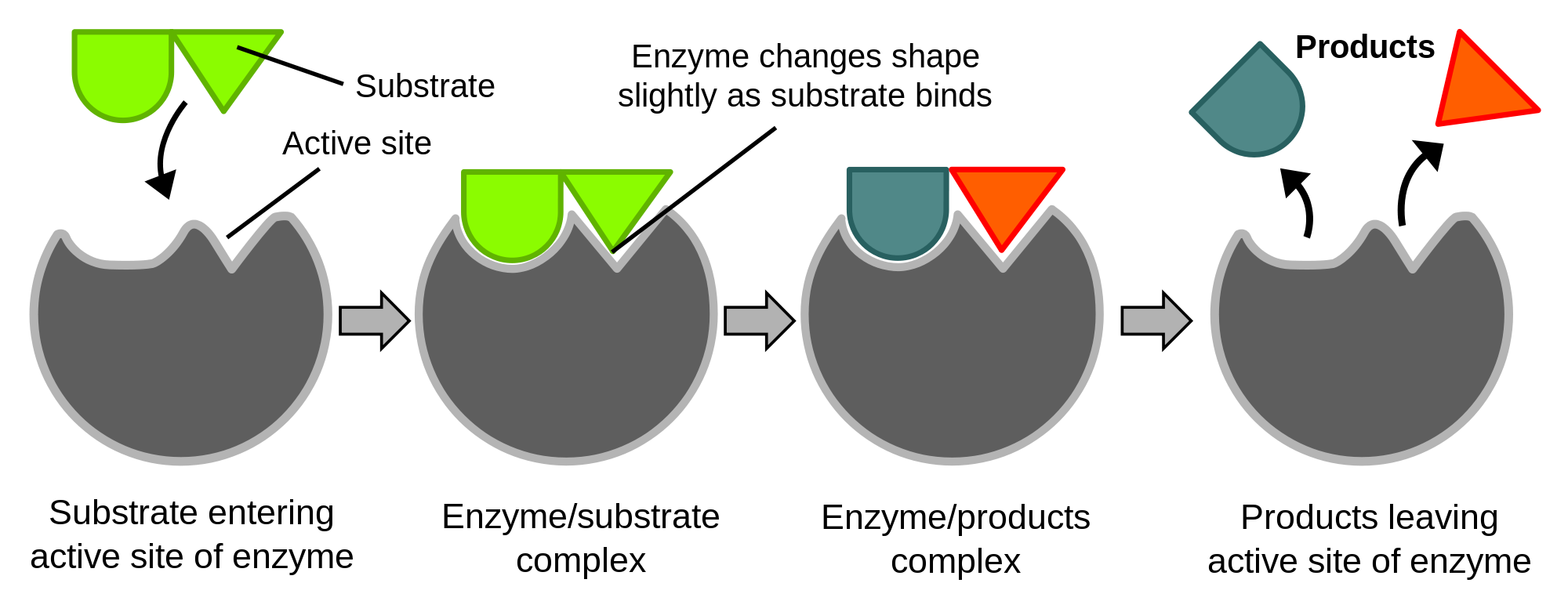
Diagram showing how an enzyme interacts with the substrate to break it down and release the products
For an enzyme to work at its best it must be in its optimum conditions, several different conditions can affect enzyme activity including temperature and pH. If the temperature or pH increases past the optimum condition then the shape of the active site changes meaning that it is no longer the correct shape to bind with the substrate and it can no longer break down the substrate.


The two graphs above show how the rate of reaction changes as the pH and temperature increases. The blue line shows the optimum condition where the rate of reaction is also at its highest, once the condition passes the optimum point the rate of reaction decreases until it reaches zero and the enzyme has been denatured.